
What is the Best Flooring for Healthcare Facilities? Safety & Hygiene Guide
On any given day, about 1 in 31 hospital patients picks up an infection after being admitted, by CDC counts. Floors do not cause most of those infections. A bad floor just makes them harder to beat.
That is why choosing flooring for healthcare facilities is a different animal than picking a floor for an office or a store. Higher stakes. Stricter rules. The surface has to survive mop water, rolling beds, and a crew that disinfects it every day.
Pacific Modular has worked on Pacific Northwest medical floors for more than 30 years, and the goal is almost always to keep a floor running rather than rip it out. A floor chosen and installed right tends to last. The options we are going to share below are the ones built to last that long.
Why Flooring Requirements for Healthcare Facilities Are Different
Good flooring for healthcare facilities does three jobs at once. It cleans up fast and disinfects fully, so germs have nowhere to hide. It takes a rolling bed or a portable X-ray unit without denting. And it grips when someone tracks in rain or a sink overflows.
So what do the flooring requirements for healthcare facilities come down to? It’s rarely a magic germ-killing additive. They come down to a hard, non-porous surface with few cracks and joints for dirt to hide in. The cleaner it stays, the better your daily disinfecting works.
Top Solutions for Commercial Flooring for Healthcare Facilities
No single product wins every room. The right commercial flooring for healthcare facilities depends on what happens in the space. Here are the three Pacific Modular installs most in medical buildings.
Sheet Vinyl, the Backbone of Vinyl Flooring for Healthcare Facilities
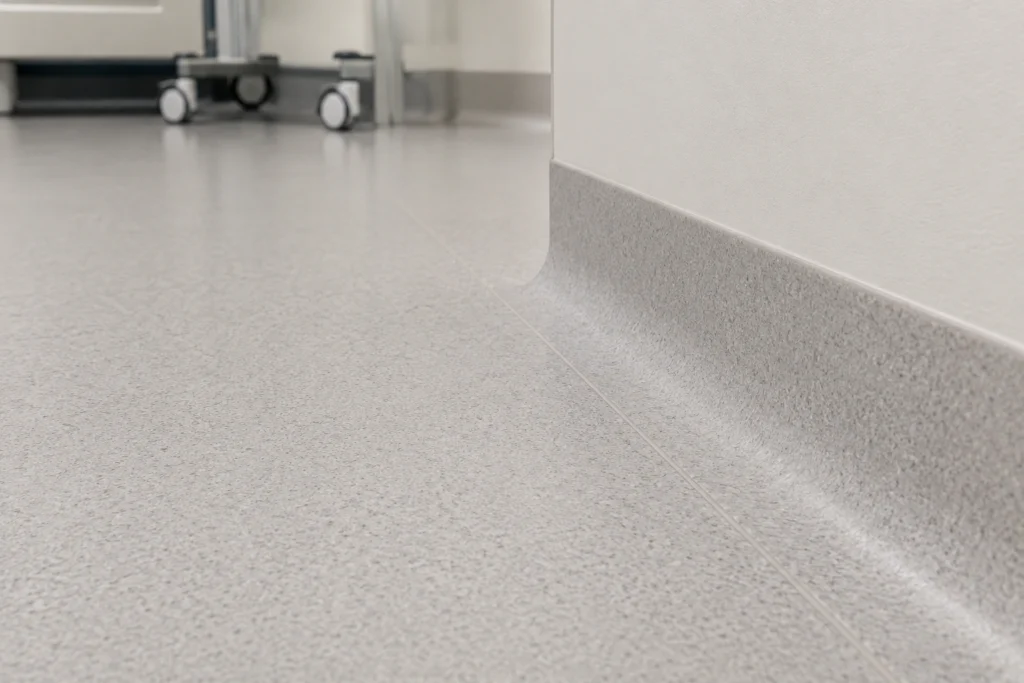
Sheet vinyl is the default in clinical areas for one reason. Crews weld the seams shut with heat, then run the floor up the wall in a curve called flash coving. That leaves a continuous surface with no open joints at the floor-wall line, exactly where soil and bacteria collect.
More often than not, when a clinic says a floor never feels clean no matter how hard the crew scrubs, the cleaning is not the problem. The floor is full of open seams and a hard corner at the wall base where a mop never reaches. Weld it and cove it, and the complaint fades.
Rubber Flooring for Comfort and Quiet
In recovery wings and any room where nurses stand all shift, rubber is hard to beat. It quiets footsteps and cushions tired joints. Upkeep stays easy too, since rubber needs no wax. The catch is price. It costs more upfront, which makes it a better fit for standing-heavy zones than a back hallway.
LVT and Tile Flooring for Healthcare Facilities
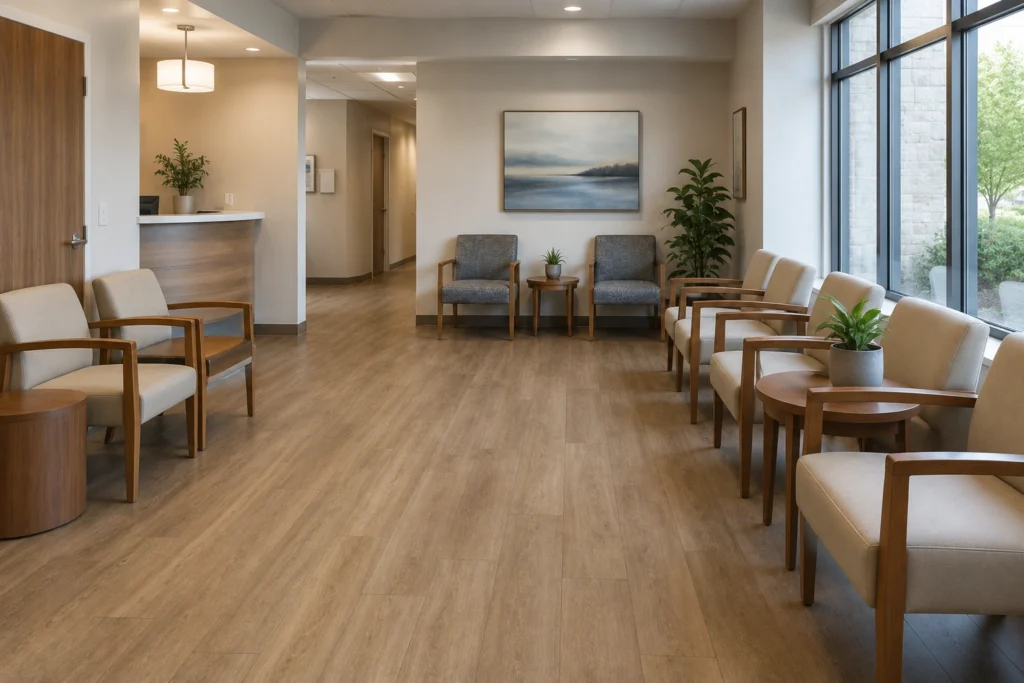
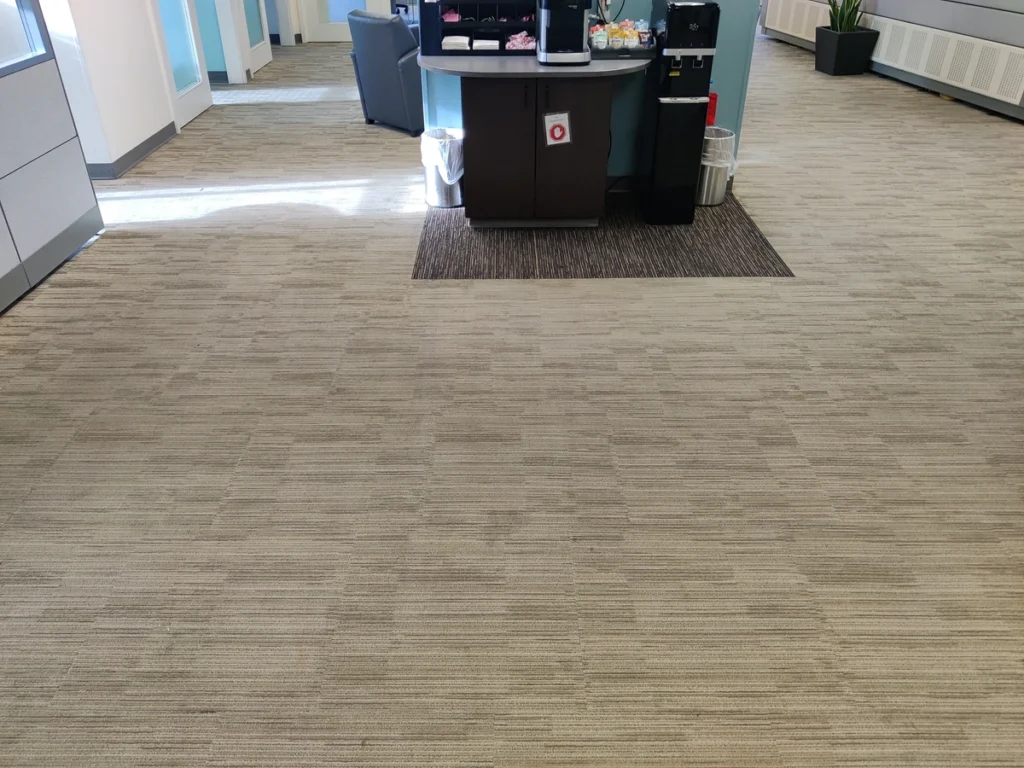
Waiting rooms and admin offices do not need a clinical look. They need to feel calm. Luxury vinyl tile brings the warmth of wood or stone with a top layer that wipes clean, common at front desks and lobbies. For wet, high-wear zones, porcelain tile flooring for healthcare facilities holds up well if it meets the slip standard below. Carpet tile fits dry admin areas only, picked for sound and comfort, never for a health claim on the label.
Healthcare Flooring in Portland and Seattle
Here is where the Pacific Northwest changes the math. A concrete slab here can stay damp well past the point where its surface looks ready. A medical floor that seals that damp slab underneath becomes a hidden home for mold and bacteria, growing right below the surface that should be the cleanest in the building. So skipping moisture testing before the install is a gamble. It is the difference between passing your infection-control review and tearing the floor back out.
Local rules matter too. Oregon and Washington both regulate healthcare construction through the FGI Guidelines, Oregon on the 2018 edition and Washington on the 2022. A crew that knows the difference saves you a failed inspection. See how that plays out for commercial flooring Seattle and commercial flooring Portland projects.
Restoring Worn Tile and Grout
Grout is the weak spot in any tile floor. It is porous, so spills and germs soak into the lines where a mop cannot reach. Scrubbing harder does not fix it. Harsh cleaners pit the grout over time, and each pit gives bacteria another place to sit.
Pacific Modular handles this with its SaniGLAZE restoration process. The tile and grout get a deep clean, then a sealed glaze bonded on top. The surface sheds dirt instead of holding it. Cleaning gets easier, and the floor you already have stays in place.
For most worn medical floors, that costs less than a tear-out and keeps the space open while it happens.
Frequently Asked Questions
What is the best floor for an operating room?
Welded sheet vinyl with coved edges, in most cases. The old answer was conductive flooring, built to bleed off static sparks when operating rooms still used flammable anesthetic gases. Those gases are gone, and the national code dropped the floor-testing rule with them. Now the priorities are a cleanable surface and toughness under heavy equipment. If a machine carries its own static spec, check it with your installer.
How do you keep a medical floor slip-resistant?
Start with a product that meets the recognized benchmark, a wet DCOF of 0.42 or higher under the ANSI A326.3 test. Then keep it that way. A floor turns slippery fast when the wrong cleaner leaves a film, so the maintenance routine matters as much as the original spec.
Why is vinyl the default in clinical areas?
It welds into one continuous, cleanable surface and costs less than most options. For exam rooms, corridors, and procedure spaces, that mix is hard to beat.
Don’t Let the Floor Be What Fails Inspection
A failed inspection or a slip claim never waits for a convenient time. Neither does a floor torn out because nobody tested the slab. A worn medical floor often does not need full replacement. The right restoration and maintenance plan brings it back for a fraction of a tear-out. Schedule a healthcare flooring consultation and we will spec it right the first time, in Seattle, Portland, or anywhere in between.