Why Does Commercial Flooring Fail?
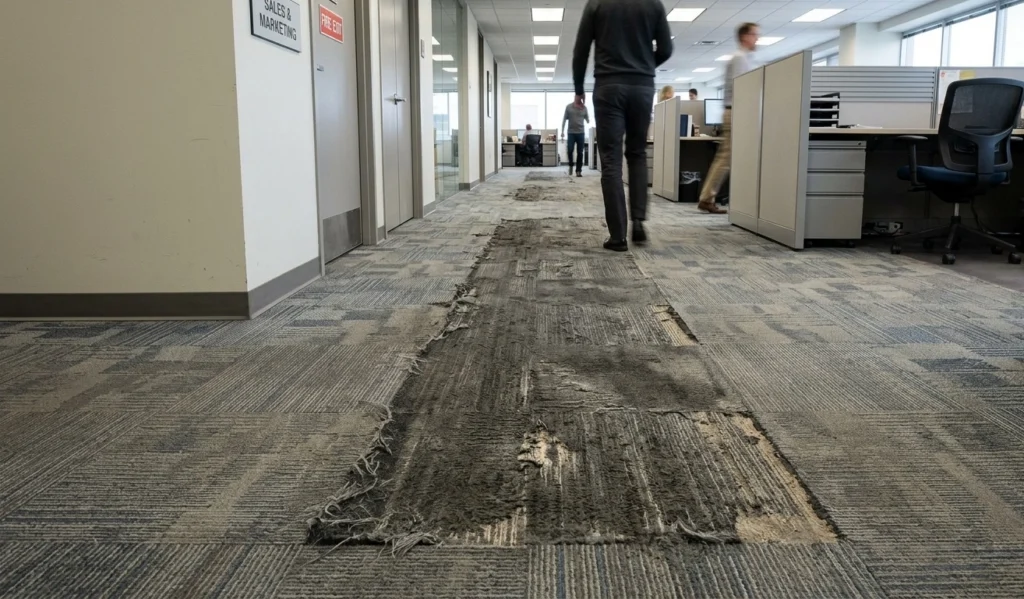
A floor lifts, cups, or wears thin two years early, and the product takes the heat. It looks like the obvious culprit, but it usually isn’t. Most commercial flooring failures have nothing to do with the flooring material itself.
They trace back to one of two things. What happened before the floor went down, or what happened to it after? Get those right, and your commercial floor lasts for years. Get them wrong, even a premium product fails fast.
Pacific Modular has spent 30 years finding the real cause under failed floors across Portland and Seattle, and the truth is almost never the floor itself. This article breaks down the five reasons commercial floors fail, from a bad subfloor to a botched commercial flooring installation, and what to look for in commercial flooring contractors so it does not happen to your building.
Understanding the Cost of Commercial Flooring Failure
Flooring failure means a floor stops doing its job before it should. That shows up as lifting planks, cupped edges, bubbled surfaces, cracked tile, or wear that cuts through the finish years ahead of schedule.
The cost lands in three places at once. You lose use of a room or a wing while crews fix it. You carry a safety risk, since a lifted tile edge is a trip-and-fall claim waiting to happen. And you get an unplanned bill, often five figures, that nobody budgeted for. A failed commercial flooring project rarely fails cheaply!
5 Common Reasons Why Commercial Flooring Fails
Most failures come down to five causes. Here they are, in the order we see them on job sites.
1. Improper Subfloor Preparation
The floor you see is only as good as the surface under it. The prep is the foundation. Rush it or skip it, and everything laid on top inherits that weakness.
Dust and debris are the quiet killers here. A thin layer of grit on the slab stops adhesive from gripping, so the bond never fully forms. An unlevel slab causes its own trouble, since every dip and high spot telegraphs up through the finished surface. Rushed prep before commercial flooring installation is one of the most common failures we find, and one of the easiest to prevent.
2. Moisture and Humidity Issues (Pacific Northwest Focus)
This one is personal for buildings here. Portland and Seattle sit in a damp climate, and concrete slabs hold and release moisture for a long time after they look dry.
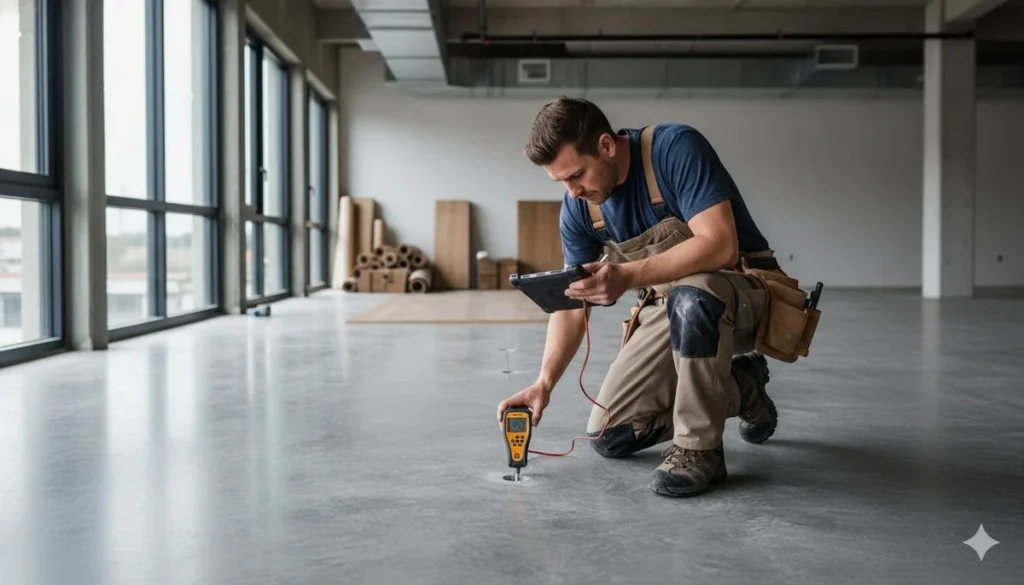
When slab moisture runs high, vapor pushes up through the concrete, causing flooring adhesives to weaken and fail. Glued-down planks start lifting at the seams, often inside a year. The test that catches this is the MVER (Moisture Vapor Emission Rate), which measures how much moisture a slab gives off. A relative humidity probe reading above roughly 75 percent is another warning sign. Skip moisture testing on a commercial flooring Seattle job and you are gambling with the whole install. The same goes for any commercial flooring Portland project, where wet winters keep slabs damp well into spring.
We see this one constantly. A medical office gets brand new vinyl plank, and within a year every seam is cupping even though the install itself looked clean. The real problem was almost always a slab nobody tested, still holding moisture underneath, and the repair ends up costing more than the original floor did.
3. Incorrect Material Selection for High-Traffic Areas
Picking a floor for looks instead of traffic load is a setup for early failure.
Residential-grade product in a busy office entrance or retail space wears out fast. It was never built for that abuse. Now, here’s where we push back on the usual advice. A back office that sees light foot traffic does not need the priciest luxury vinyl on the rack, so do not let anyone upsell you there. But a lobby that moves 500 people a day needs a true commercial-rated wear layer, full stop. Match the floor to the traffic if you want it to last for years.
4. Poor Adhesive Application or Product Incompatibility
Adhesive seems simple. It is not.
Most adhesives need flash time, the window they sit open before the flooring goes down. Rush that window, and you trap solvent under the floor, which shows up later as bubbling. Use an adhesive that does not match the flooring backing, and the bond never sets right. Either mistake gives you the same result. That’s often peeling, lifting, a floor that fails in patches instead of all at once.
5. Lack of Professional Maintenance Post-Installation
A clean install can still fail if the wrong cleaning routine follows it.
Harsh or wrong-pH cleaners strip and break down commercial finishes faster than foot traffic does. The fix is a maintenance plan matched to your specific floor type. A generic mop-and-go routine will not cut it. After thirty years of pulling up floors, Pacific Modular has learned one thing for certain. A worn floor rarely needs replacing. Proper restoration and maintenance usually fixes it for a fraction of what a full tear-out costs.
How to Prevent Flooring Failure in Portland and Seattle
Prevention is not complicated. It comes down to two things.
First, the technical audit. Pre-installation moisture testing is non-negotiable in this climate. A proper test before the floor goes down catches the single most expensive failure mode before it ever starts.
Second, the team. The right commercial flooring contractors prevent these failures because they have seen them all before. Look for a few things when you vet a contractor:
- Local track record with Portland and Seattle buildings and codes
- A documented prep and moisture-testing process, not a verbal promise
- References from buildings like yours
- Honesty about real-world lifespan, not just the warranty number
The largest commercial flooring contractors in the region all share that last habit. They test, they document, and they tell you the truth. You can see how that approach works for commercial flooring in Seattle or for commercial flooring in Portland.
Frequently Asked Questions
How long should commercial flooring last?
Most commercial floors are built to last 10 to 20 years, depending on the product, the traffic, and the maintenance. Manufacturer warranties often quote 15 years or more, but a real building with real traffic and a few maintenance gaps tends to show its age closer to years 8 to 12.
Can you install new flooring over old commercial floors?
Sometimes. It depends on the condition of the existing floor and the subfloor beneath it. Going over the old floor can save time and money, but only after an inspection confirms the base is dry, sound, and level. A skipped inspection just hands those hidden problems straight to the new floor.
What is the most durable flooring for a high-traffic office?
Commercial-grade luxury vinyl tile (LVT) is one of the most popular flooring options for high-traffic offices due to its durability and low maintenance requirements. While VCT remains widely used in commercial environments, its performance depends on regular waxing and refinishing.
In facilities with heavy rolling loads, polished concrete or industrial-grade epoxy flooring typically offers greater long-term durability. The right choice ultimately depends on the specific traffic conditions and maintenance resources available.
What are the most common causes of commercial flooring failure?
Five causes account for most of it. Think poor subfloor prep, slab moisture, the wrong material for the traffic, adhesive problems, and a bad post-install cleaning routine.
Which commercial flooring is most durable for high-traffic offices in 2026?
Commercial luxury vinyl tile is still the practical default for most offices in 2026, since it balances durability, cost, and easy repair. For the heaviest-use spaces, polished concrete and epoxy systems lead the pack.
Conclusion (Protecting Your Investment)
A floor failure is never just a floor problem. It closes a room your staff needs, it puts a trip hazard in a space the public walks, and it drops an emergency bill on a budget that had no room for one.
You can get ahead of all three. A proper site assessment catches moisture, subfloor, and material problems before they cost you, and Pacific Modular has spent over 30 years doing exactly that across the Pacific Northwest. Schedule a site assessment for your building in Seattle or Portland, and find out what your floor needs before it tells you the hard way.